
Most criminal cases in Arkansas end without a trial. Some shouldn’t. When the facts are disputed, the evidence is thin, or the stakes are too high to accept an offer, a jury trial is how a case gets decided. If you have been charged with a felony in Craighead County, here is what a felony jury trial usually looks like, step by step.
Where Felony Jury Trials Happen in Craighead County
Felony cases are tried in circuit court. Craighead County is part of Arkansas’s Second Judicial Circuit and has two courthouses, one in Jonesboro and one in Lake City. Your paperwork will tell you which courtroom and which judge your case is assigned to. The steps below follow Arkansas statutes and court rules, so the same basic process applies in circuit courts across the state.
Before Trial: Deadlines and Preparation
Arkansas has a speedy-trial rule. In general, a defendant who is out on bond is entitled to have the charge dismissed if the State does not bring the case to trial within 12 months, not counting delays the rules allow, such as continuances the defense requests (Ark. R. Crim. P. 28.1). A defendant held in jail must be released on his own recognizance if not tried within nine months. These periods are calculated under detailed rules, so the exact deadline in any case has to be worked out carefully.
Before trial, the defense reviews the State’s evidence, investigates, interviews witnesses, and files motions. Some motions ask the court to keep out evidence that was gathered unlawfully or that the rules of evidence don’t allow. How those motions come out often shapes whether a case goes to trial at all.
Picking the Jury
A felony jury in Arkansas is made up of 12 jurors (A.C.A. § 16-32-202). Jury selection, called voir dire, is where the lawyers and the judge question potential jurors about their backgrounds and any views that might keep them from being fair.
Either side can ask the judge to remove a juror for cause, such as a juror who knows a witness or admits he can’t be impartial. Each side also gets a set number of peremptory challenges, which remove jurors without giving a reason. In most felony cases, the defense gets eight and the State gets six. In capital cases, the defense gets twelve and the State gets ten (A.C.A. § 16-33-305). Peremptory challenges still can’t be used to exclude jurors because of race or sex.
In my experience, jury selection is one of the most important parts of a trial, and one of the most overlooked.
The Guilt Phase
Once the jury is seated, the trial itself begins.
- Opening statements. Each side previews what it expects the evidence to show.
- The State’s case. The prosecutor calls witnesses and offers evidence. The defense cross-examines each witness.
- Motion for directed verdict. When the State rests, the defense can ask the judge to rule that the State’s evidence is not enough to send the case to the jury.
- The defense case. The defense may call witnesses, but it does not have to. A defendant has a constitutional right not to testify, and the jury can be instructed that it may not hold that silence against him.
- Instructions and closing arguments. The judge instructs the jury on the law, and each side argues what the evidence proves.
Throughout, the burden stays on the State. No one can be convicted unless each element of the offense is proved beyond a reasonable doubt (A.C.A. § 5-1-111). The jury’s verdict in a felony case must be unanimous.
The Sentencing Phase
Arkansas is one of a handful of states where juries decide the sentence in felony cases. Trials are split into two parts (A.C.A. § 16-97-101). If the jury finds the defendant guilty, it then hears more evidence about sentencing, such as prior convictions, the impact on any victim, and evidence about the defendant’s life and character. The jury then decides a sentence within the range the law sets for that offense.
The court may also let the lawyers argue for alternative sentences, such as probation, and the jury may recommend one, though that recommendation does not bind the judge. With the State’s agreement and the court’s consent, a defendant can also choose to have the judge, rather than the jury, decide the sentence.
This two-part structure matters when deciding whether to go to trial. The question isn’t only whether the State can prove the charge, but also what a jury is likely to do at sentencing.
Deciding Whether to Go to Trial
Whether to plead or go to trial is your decision, not your lawyer’s. A good lawyer gives you an honest assessment of the evidence, the possible sentence, and the risks on both sides, so you can make that decision with your eyes open. In addition to my private practice, I have served as both a public defender and a deputy prosecuting attorney, handling hundreds of cases from traffic tickets to murders, and I take a select number of private criminal cases, usually the difficult ones that are likely headed for trial.
If you or someone you love has been charged with a serious felony in Craighead County or anywhere else in Arkansas, you can read more on my criminal defense page or call my office at 870.525.2191. We’ll talk briefly about the case to see whether it is a fit.
This post is general information about Arkansas law, not legal advice for your situation.
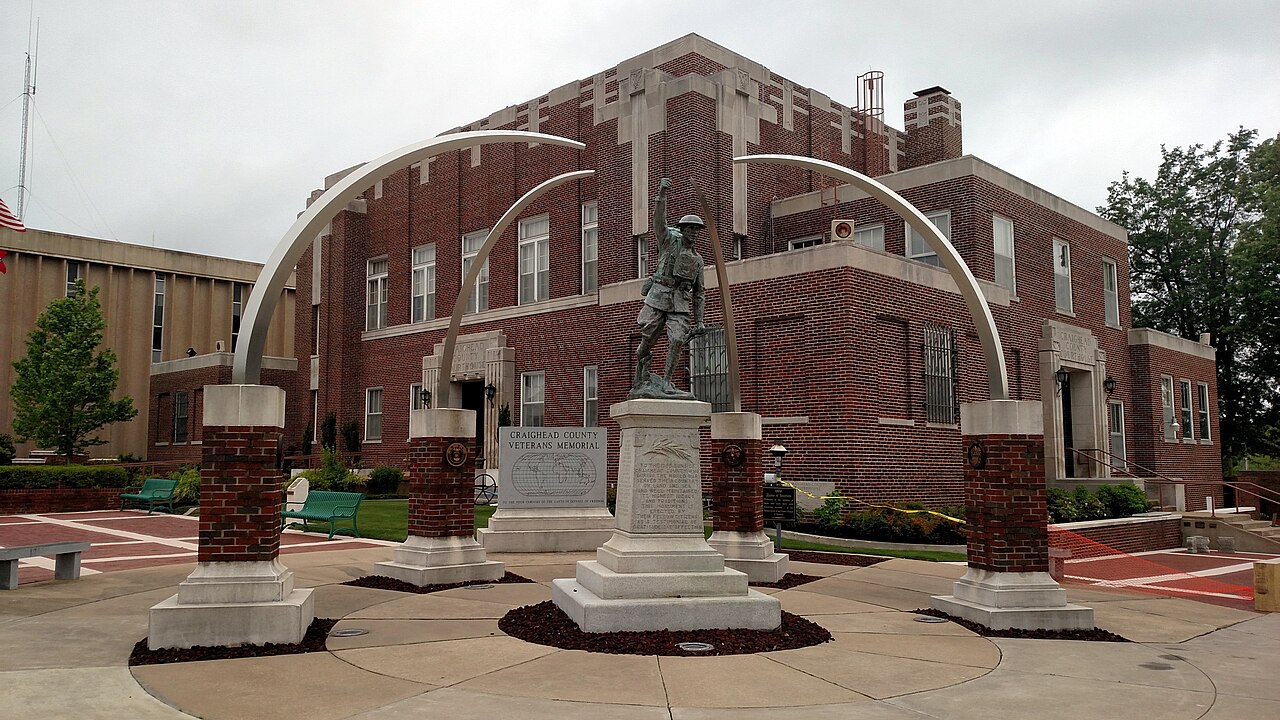
Photo at top: Craighead County Courthouse, Jonesboro. Photo by Brandonrush, CC BY-SA 4.0, via Wikimedia Commons.